
The Boss · 2018–2027
Hajime Moriyasu
Hiroshima's own. The man who beat Germany and Spain, and never once made it about himself.
Head coach of Japan · 2018 through the 2027 Asian Cup
森保 一
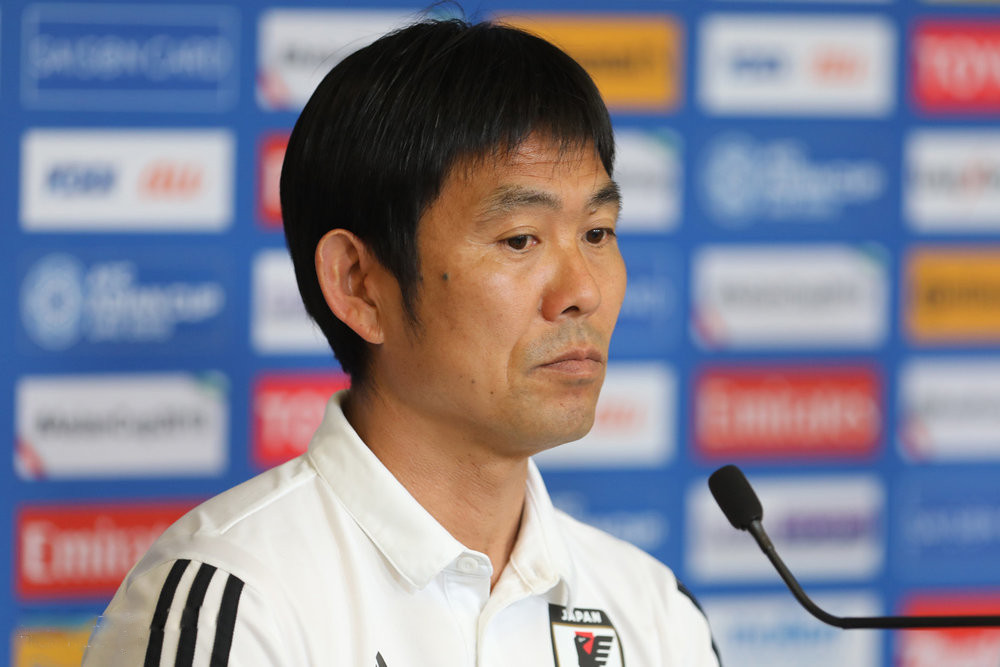
He has been part of Japan's story for more than thirty years: a title-winning player in the 1990s, the most decorated club manager of his generation, an assistant on the bench for the cruelest night in the team's history, and then, for eight years, the boss. He is not a showman. He is something rarer, a winner who gives every ounce of himself and hands the credit to everyone else. This is the full story of the boss.
- Born
- August 23, 1968 · Shizuoka
- As a player
- Midfielder · 35 Japan caps
- Home for 14 years
- Mazda / Sanfrecce Hiroshima
- Russia 2018
- Assistant to Nishino
- Japan head coach
- from July 26, 2018
- Steps aside
- after the 2027 Asian Cup
Career honors
As a player
- AFC Asian Cup winner (1992, under Hans Ooft)
As a manager
- J1 League champion ×3 with Sanfrecce Hiroshima (2012, 2013, 2015)
- Japanese Super Cup ×3 (2013, 2014, 2016)
- J.League Manager of the Year ×3
- Round of 16 at the 2018 World Cup (assistant to Nishino)
- AFC Asian Cup runner-up with Japan (2019)
- EAFF E-1 champion ×2 (2022, 2025)
- AFC Coach of the Year (2022)
- Wins over Germany and Spain at the 2022 World Cup
- Two World Cups as Japan head coach (2022, 2026)
One of us first: the playing years
Before the technical area, Moriyasu was a player, and a Hiroshima man to the core. He joined Mazda SC in 1987, the club that became Sanfrecce Hiroshima when the J.League was born, and gave it fourteen years and more than 270 appearances as a tireless, goal-getting midfielder. In 1998 he spent a season on loan at Kyoto Purple Sanga, arranged by none other than Hans Ooft, the very coach who opens this lineage. He finished his playing days at Vegalta Sendai in 2003.
For Japan he won 35 caps between 1992 and 1996. And here is the detail that ties him to the top of this page: he was part of the squad that won the 1992 Asian Cup under Ooft, and part of the generation that lived the Agony of Doha in 1993. The heartbreak and the glory that begin this whole story, he felt both as a player.
Learning the trade, then winning everything at home
Moriyasu built his coaching craft the patient way. He went back to Sanfrecce as a coach in 2004, and it was here that his life with the national team quietly began: he was seconded onto Japan's youth-team staff for the 2006 AFC Youth Championship and the 2007 Under-20 World Cup, long before anyone imagined him running the senior side. A brief spell at Albirex Niigata followed. Then, in 2012, he took the Sanfrecce hot seat and turned it into one of the great J.League sides of the era: three J1 League titles in four seasons (2012, 2013, 2015), three Japanese Super Cups, and Manager of the Year for each of his championship years.
Three titles in four years is not luck. It is a man who knows how to build a team that lasts a whole campaign, the exact quality the JFA leaned on when they chose him.
Russia 2018: on the bench for the heartbreak
Here is the part you might have spotted yourself. After leaving Sanfrecce, Moriyasu took over Japan's Olympic Under-23s, and when Akira Nishino was handed the senior team weeks before the 2018 World Cup, Moriyasu went to Russia on his staff. He was right there on the touchline for the round-of-16 night against Belgium: two goals up, and then undone 3-2 in the final seconds, one of the cruelest defeats in Japan's history.
Two weeks later, on July 26, 2018, the JFA handed him the whole team. That is the baton pass from Nishino that his July 2026 farewell press conference kept returning to, and it was not a metaphor. He caught it in person, in the wreckage of that Belgium match. It is why he understands better than anyone what it means to hand the next man a live, beating team rather than a rebuild, and why he is so determined to do the same for Oiwa.
Eight years as the boss
As head coach from July 2018, often doubling up with the Olympic side, Moriyasu quietly dominated Asia. He took a young Japan to the 2019 Asian Cup final, finished fourth at his home Tokyo 2020 Olympics, and won the regional E-1 title in 2022 and 2025. Qualifying campaigns were controlled and ruthless, and in 2022 he was named AFC Coach of the Year.
The tournaments told the story of a team that could beat anyone but had not yet broken through: a penalty exit to Croatia in the 2022 round of 16, a quarterfinal at the 2023 Asian Cup, and a Round-of-32 exit to Brazil at the 2026 World Cup. The breakthrough never quite came. The belief he built did.
The nights we will never forget
Germany 2-1. Spain 2-1. Ask any of us where we were for those two nights in Qatar and you will get a story. It was the high-water mark of a generation of Japan support: the moment the away ends in blue realized they were not just there to make up the numbers. Moriyasu built that. A team, and a belief, that outlived the scoreline.
The man himself
What sets Moriyasu apart is not tactics, it is character. He is loyal, humble to a fault, and he carries the weight of the job like a personal debt to the people who support the team. At his final contract press conference he broke down mid-sentence, unable to speak for the better part of ten seconds, on the words “for Japan.” Not for his job. Not for his legacy. For all of us.
That is who he is. A man who cared, completely, to the very end.
The send-off
Moriyasu leads Samurai Blue through the AFC Asian Cup in Saudi Arabia this January and February, and then hands the baton to Go Oiwa. Eight years, two World Cups, and one more tournament to send him off the way he deserves.
Let's make January loud. 🔵🌊🇯🇵⚽